


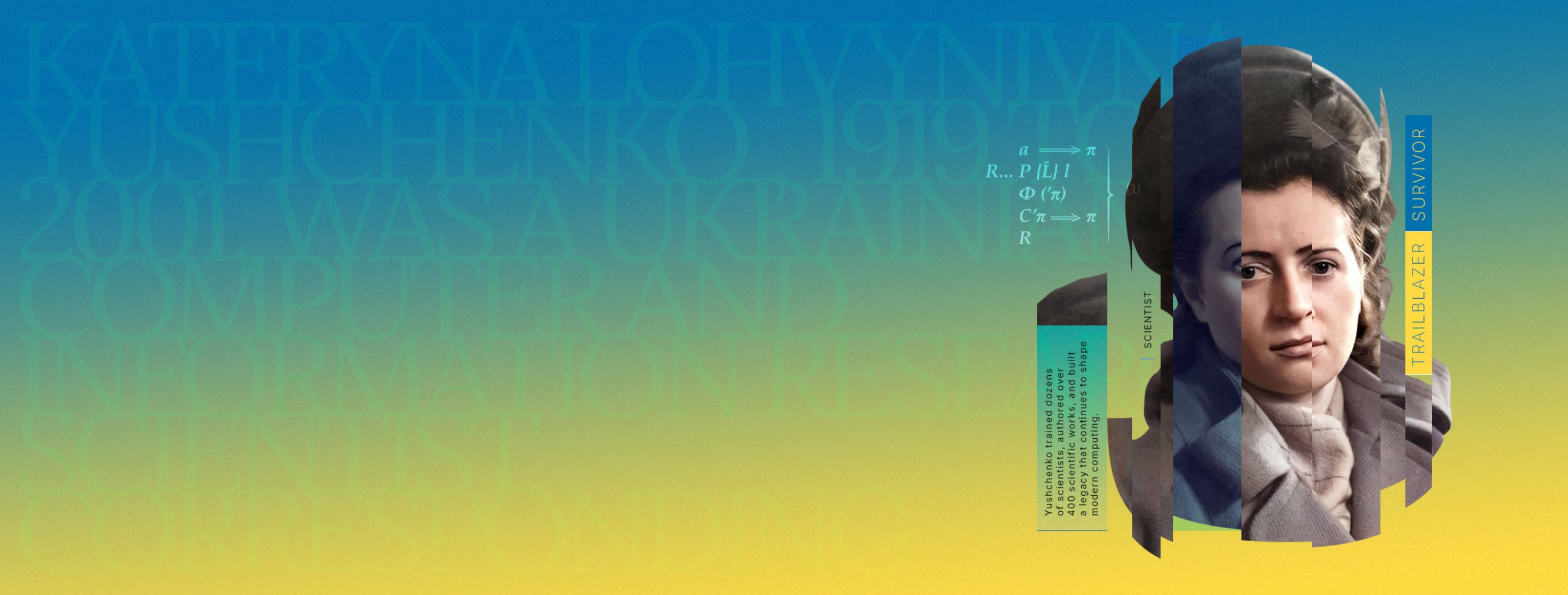
Blue & Yellow: Uncovering Ukraine is a series of short stories about remarkable Ukrainians whose contributions have elevated science and technology worldwide. Discover more inspiring profiles in this series.
Created One of the World’s First High-Level Programming Languages
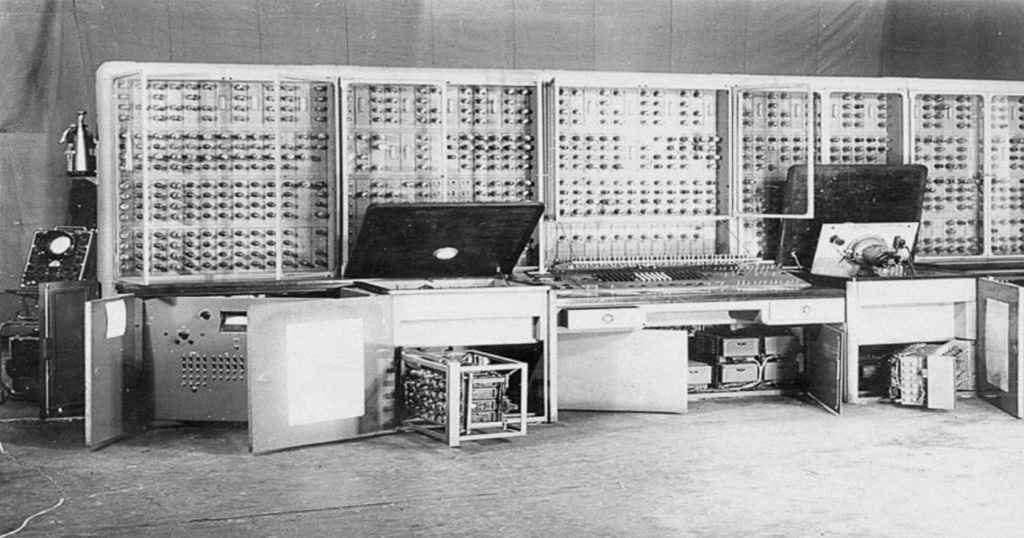
Kateryna Yushchenko (1919–2001) was a pioneering Ukrainian scientist and programmer. In the 1950s, she was among the first to work on the MESM, the first electronic digital computer in the USSR and continental Europe. She also played a leading role in developing the unique Kyiv computer, designing both its architecture and software.
But her path to becoming a trailblazer in programming was far from easy.
Early Life & Education Under Oppression
Kateryna developed a passion for mathematics at a young age. However, her journey was marked by political persecution. In 1937, her father was arrested as a “nationalist,” and her mother, while trying to defend him, was sentenced to 10 years in prison and never returned.
Despite her academic potential, Kateryna was expelled from Kyiv State University due to the political charges against her family.
“I was 17 years old, I firmly believed Stalin’s words, ‘a son is not responsible for his father,'” she later recalled.
With few options, she found refuge at Samarkand University in Uzbekistan, one of the only institutions that offered a scholarship and dormitory placement.
“After all the tolls and humiliations when trying to continue science, this seemed like possible salvation. I devoted myself to my studies… The opportunity to finally complete my education gave me wings and helped me survive the calamity. But I always remembered my parents and such a distant Ukraine.”
She graduated with honors in 1942 and returned to Ukraine after the war.
A Career in Science and Programming Innovation
Yushchenko joined the Institute of Mathematics of the Academy of Sciences of the Ukrainian SSR, first in Lviv and then in Kyiv. She worked under Borys Hnedenko, a prominent mathematician who recognized her talent early on.
Between 1950–1957, she served as Senior Researcher at the Kyiv Institute of Mathematics. In 1954, when the Lebedev Laboratory (home of MESM) merged with the institute, she became part of the team operating one of the first digital computers in Europe.
In 1957, Yushchenko became Director of the Institute of Computer Science of the Ukrainian SSR Academy of Sciences, where she served for over four decades.
The Address Programming Language: A Revolutionary Achievement
Yushchenko is best known for creating the Address Programming Language, a groundbreaking development that allowed programs to be written with flexible memory locations—a major leap beyond machine-level code.
While working with MESM, the team realized that solving complex problems required a new, high-level programming language. With support from mathematical logic experts like L.I. Kaluzhnin, Yushchenko formulated a language based on principles of addressing and software management. It introduced the manipulation of second-rank addresses (pointers) and beyond—essentially creating the foundation of theoretical programming in the Soviet Union.
This innovation led to the formation of the first Soviet School of Theoretical Programming, which flourished throughout the 1970s–1980s.
Legacy and Global Recognition
Kateryna Yushchenko’s scientific contributions span probability theory, algorithmic languages, automated data processing systems, and the training of future programmers.
She authored over 400 scientific works, including 24 monographs and textbooks. Many were reprinted and translated into German, Czech, Hungarian, Romanian, French, Danish, and more.
She trained 47 PhD candidates and 11 Doctors of Science, and her Kyiv school of programming gained recognition well beyond the Soviet Union.
Her honors include:
🏅 Two State Prizes of Ukraine (Ukrainian SSR)
🏅 Prize of the Council of Ministers of the USSR
🏅 The Glushkov Academic Prize for her contributions to computer algebra
Kateryna Yushchenko’s story is a testament to resilience, intellect, and groundbreaking innovation—a Ukrainian scientist whose work shaped modern computing as we know it.
Sources: